
JOURNEY BACK IN TIME
1962: The First Batch of IIT Bombay – Where It All Began
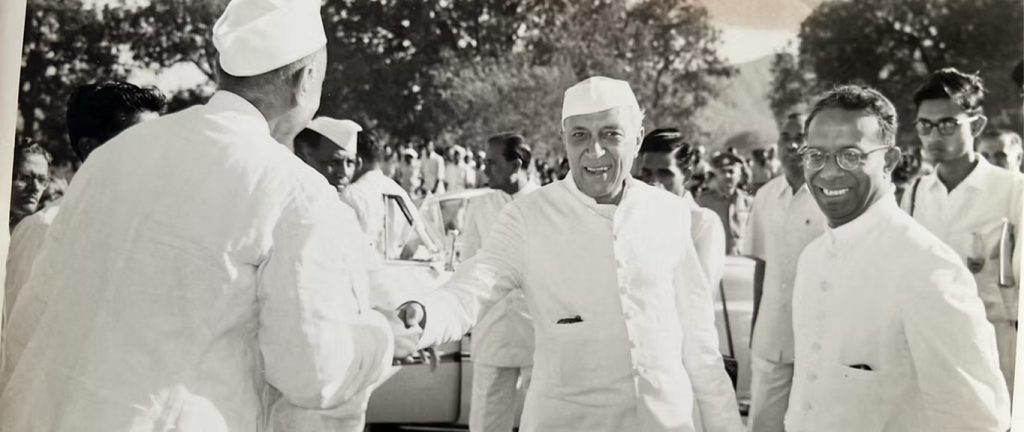
At the Foundation Laying ceremony in Powai on March 10, 1959. Beside Pandit Nehru is Humayun Kabir, then Union Minister for Scientific Research and Cultural Affairs. They are greeted by Kasturbhai Lalbhai, Chairman of the IIT-B Governing Board.
All black-and-white photos and most of colour photos are courtesy of Dr. Sudhir Sharma’s book ‘The Pioneers: Story of the First Batch of IIT Bombay’ and IITB brochures.
********************
The story of IIT Bombay’s first graduating class is, in many ways, the story of the Institute itself. In a richly researched feature, Mumbai-based journalist Ms. Meher Marfatia traces the extraordinary journey of the pioneering Class of 1962 through conversations with members of the inaugural batch, including Dr. Sudhir Sharma, Mr. Jugal Tandon, Mr. Bonnie Dias, and Mr. Krishen Khanna.
Drawing on Dr. Sharma’s extensive archival collection of photographs and historical material from his book, The Pioneers – Story of the First batch of IIT Bombay, 1958 – 1962, along with interviews and personal recollections, the article brings alive the formative years of IIT Bombay: from its temporary beginnings in Worli to the creation of the Powai campus and the lifelong bonds forged by the students who helped shape the Institute’s legacy.
We are delighted to feature Ms. Marfatia’s rich article in this edition of the Dean ACR newsletter. In her feature, she brings together the memories and reflections of the first graduating class, offering a glimpse into the people and moments that shaped IIT Bombay’s earliest chapter.
***This piece appeared originally on www.mehermarfatia.com and has been reproduced verbatim below.***
“As the first IIT-B batch, we watched history in the making”
Catching up with the inaugural batch of engineers from IIT Bombay: its Class of 1962
Stories sprout stories. This one swelled slowly from my piece on a little lane leading into Bandra bazar. “I belong to the first IIT Bombay batch of students,” Bonnie Dias casually mentioned when I interviewed him last year about his ancestral home on Boran Road.
Not only does Dias happen to be from the first graduating class of the Indian Institute of Technology Bombay (1958-1962), he is also in regular touch with octogenarian batchmates settled worldwide.
This is their story.
In July 1958, about 100 students from over 3,400 applicants across India were admitted to the first year of a four-year engineering degree course at IIT Bombay (IIT-B), culminating in a B. Tech (Hons) degree. Final year exams finished seven months prior to when 72 of this first batch of students formally graduated at the convocation in December 1962. They take immense pride in the fact that they were groomed to not only mould the world-famous reputation of their alma mater but, more significantly, contribute to the progress of their country.
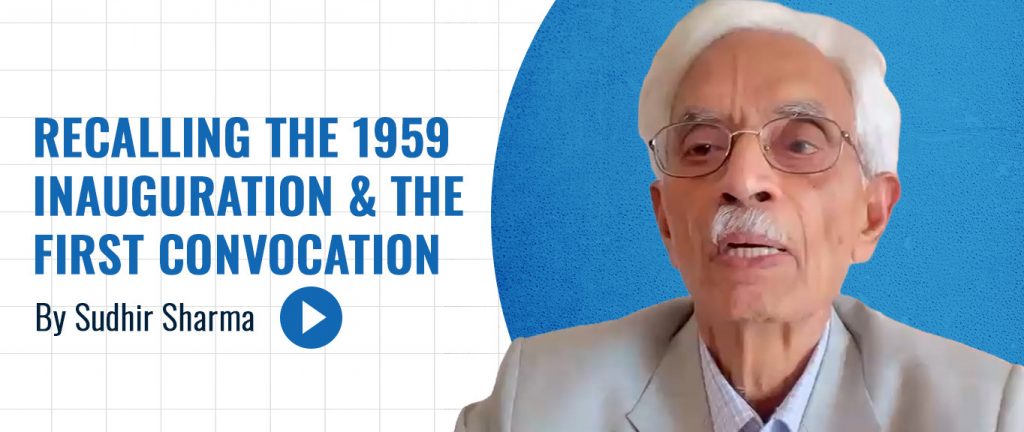
Sudhir Sharma on the excitement of ceremonies like the 1959 inauguration of the Powai institute and the
December 1962 convocation of their first batch
“As the first class of IIT-B we were in a position to watch history in the making, in which we were the players,” says New York-based Sudhir Sharma, who majored with Metallurgical Engineering. “Setting the tone of excellence for batches to follow, our grounding gave us the capability and courage to venture out and contribute to universal improvement.”
Born in Worli
After Independence, the Indian government began encouraging rapid industrial growth and perceived a need for increased engineering and scientific personnel in the country. Along with setting up industrial plants, new engineering colleges were planned. Of the four initial IITs for higher learning, IIT Bombay was the second to open doors on July 25, 1958, after IIT Kharagpur in 1951. The third and fourth were IIT Madras and IIT Kanpur, both in 1959.
There was no IIT Powai campus till 1959. Classes were held in SASMIRA (Synthetic and Art Silk Mills Research Association) building on Annie Besant Road in Worli – a marble landmark with oblong architecture. In this temporary rented space, IIT-B was given the right half side three floors – second to fourth – for classes and laboratories with workshops at ground level. Out-of-town students rode BEST double-deckers from their Worli Naka hostel in Shiva E Namah Building, admiring the peach-coloured LADA-make Russian cars of some academicians, standing out among Ambassadors and Fiats on the road.
For the first two years, everyone attended the same classes in science, engineering and liberal arts subjects like Logic and Ethics. For the remaining years they separated into selected fields in the five divisions – Civil, Mechanical, Electrical, Chemical and Metallurgical Engineering, according to each one’s chosen field of degree.
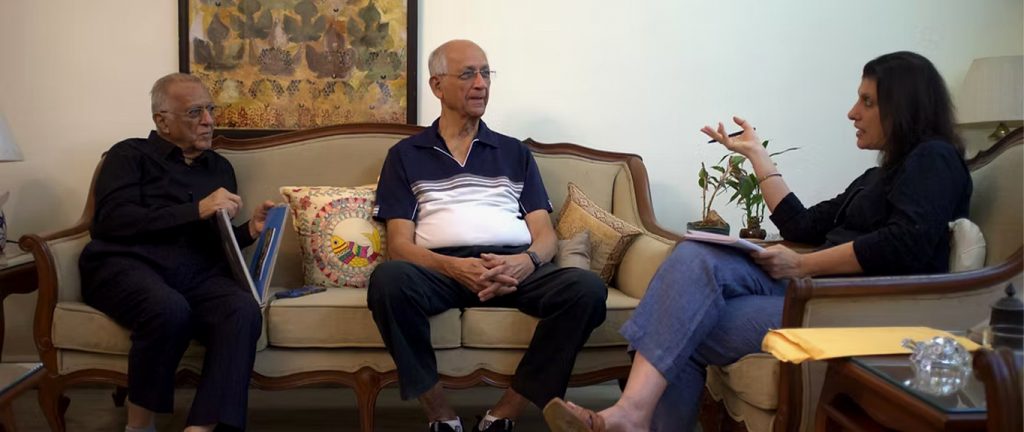
With Jugal Tandon and Bonnie Dias, in Tandon’s Bandra home
Chatting with 86-year-olds Dias and Jugal Tandon (metallurgical engineers, again), I enjoy an exchange of sharp anecdotal memories of what they consider the best years of their eight decades. “I joined fresh from Inter Science at St Xavier’s College, while Jugal did from Ajmer,” says Dias. “Initially total strangers to each other, we gradually got to know everyone well. Eight or ten to a room, we heard each other’s snoring and dreams. I was glad to go home for meals from Worli. For the majority, their hostel food was bad. Classmates from North India and the South asked, ‘Tum log kya kha rahe ho?’”
Tandon reiterates: “It was terrible food. But who will come to cook in a forest? That’s how wooded Worli was in the 1950s. Our hostel being right beside City Bakery, we longingly smelt the bread and cake. We entertained ourselves staging room-vs-room pillow fights. Once a week we went for a walk along Worli sea face.”
Another metallurgical engineer, PK Rao wrote, in the commemorative book titled The Pioneers: Story of the First Batch of IIT Bombay: “Whereas our Warden, Dr Shah, was a dignified, respect-commanding type, our so-called Warden, Paul Choudhary, mingled with us. I’d hum the song ‘Mera naam chin chin chu’ and when he took attendance at night, he asked, ‘Is Mr Chin Chin Chu present?’”
As editor of this souvenir volume published in 2012 on the occasion of their golden jubilee, Sharma explains, “The book was intended to convey to posterity the joys and achievements, the troughs and triumphs of our pioneering batch.”
Moving to Powai
“It was truly inspiring to hear Pandit Nehru speak about building the nation,” says Tandon, recalling the opening of the main Powai building on March 10, 1959 by Prime Minister Jawaharlal Nehru. After laying the foundation stone, Nehru was driven around the campus in a jeep by the institute Director himself, Brigadier SK Bose.
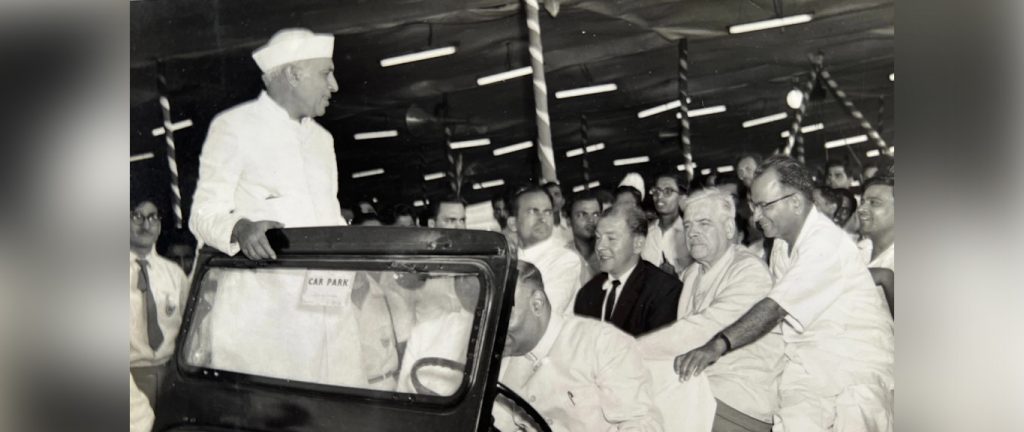
Nehru being shown around the campus in a jeep driven by the Director, Brigadier SK Bose. The bespectacled young student seen standing between two Russian advisors in the rear seat is Sudhir Sharma, hoping to get an autograph of the PM
Describing activity at the site before that momentous day, Sharma says, “Curious to see our future home, in December 1958 six of us went to survey the campus, in a forest on the eastern shores of Powai Lake. A large area in the centre was cleared for the main building. We volunteered to help dignitaries from other cities arriving for the inaugural function. I was fortunate to take a photo of Panditji, though it was a bit dark, under-exposed. I consider myself very lucky to witness this historic event in which all IITians participated.”
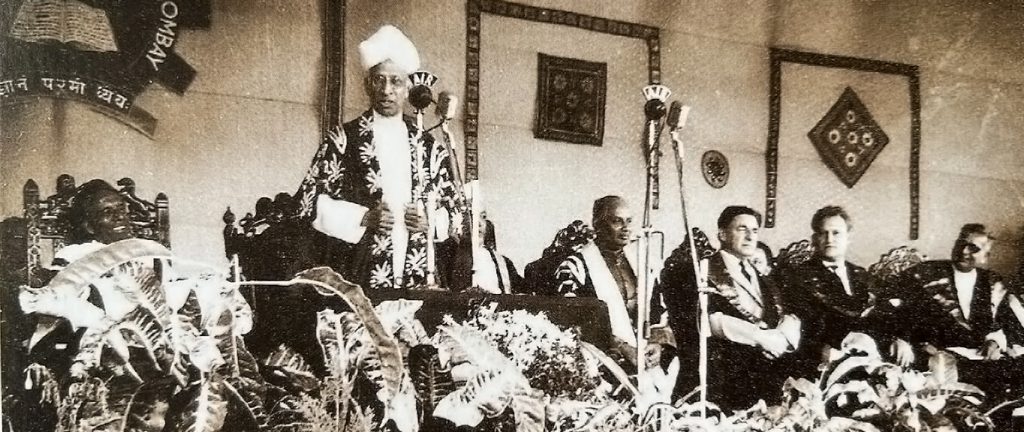
Dr Sarvepalli Radhakrishnan, second President of India, at the historic first convocation on December 22, 1962. Photo: Anil Anvikar
When students arrived at Powai at the beginning of the second year, July 1959, only one hostel (called Hostel No. 1) was constructed; two others were near completion. They shared rooms for the first semester, then moved to all three hostels in the second. Sharma says, “Classes were held in the main building’s first and second floors. The campus was being built around us. By the third year, all five department buildings were constructed.”
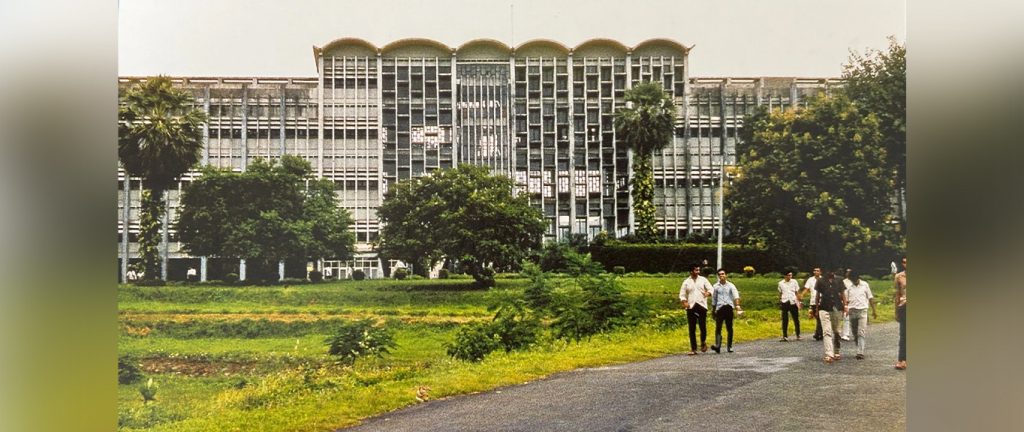
The IIT Powai campus photographed by Sudhir Sharma in August 1969 and (below) January 1972
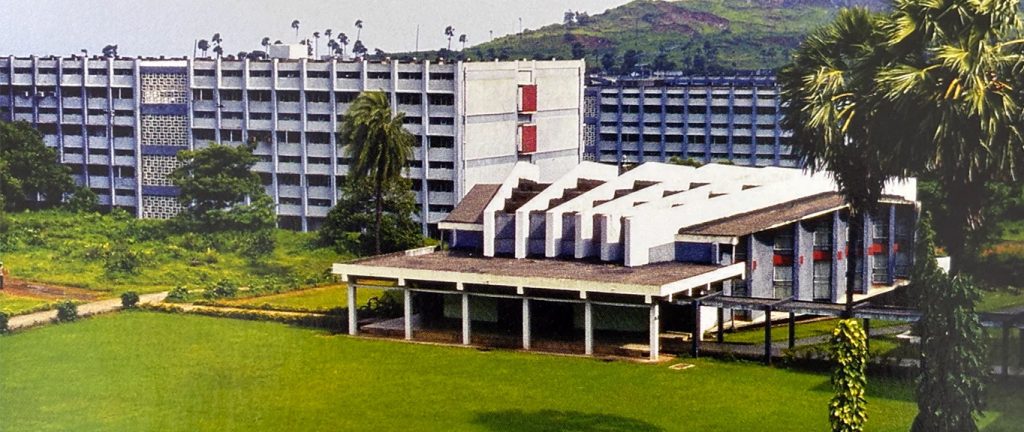
Till residential staff quarters were erected on the jungle turf, teachers travelled from homes elsewhere in Bombay. Alighting at Vikhroli railway station, they caught an IIT-B bus to campus.
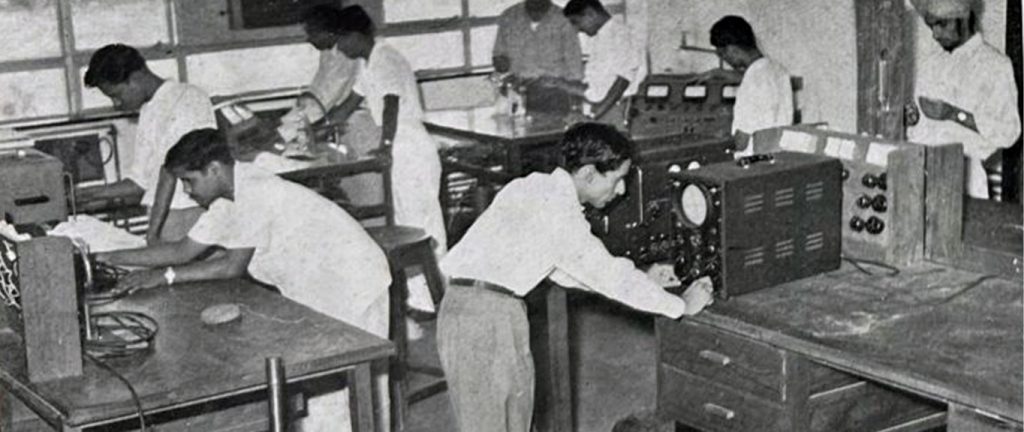
Students in the electro-vacuum technology lab
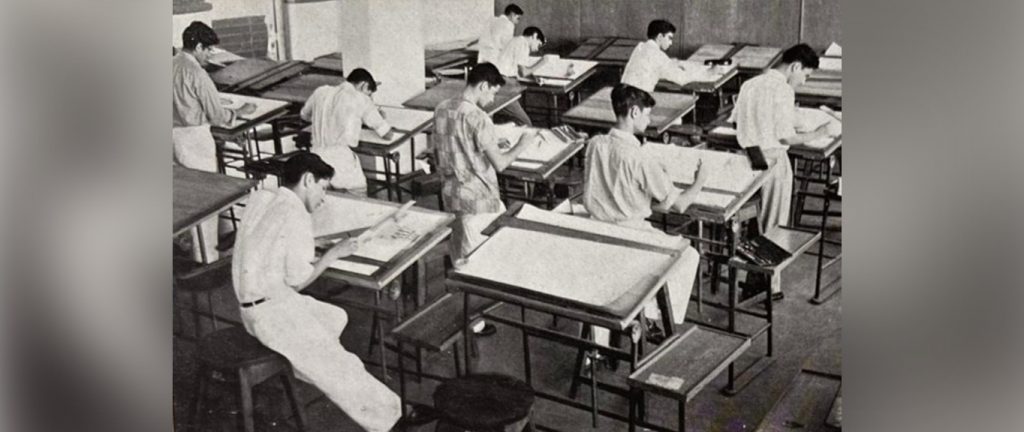
First year drawing class
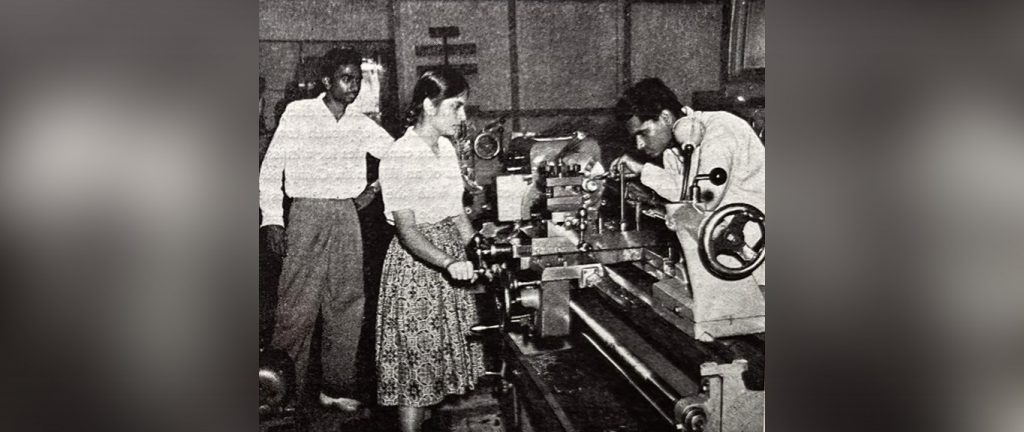
Tejaswini Saraf, the first woman to join IIT-B in the early 1960s, learning to work a lathe machine
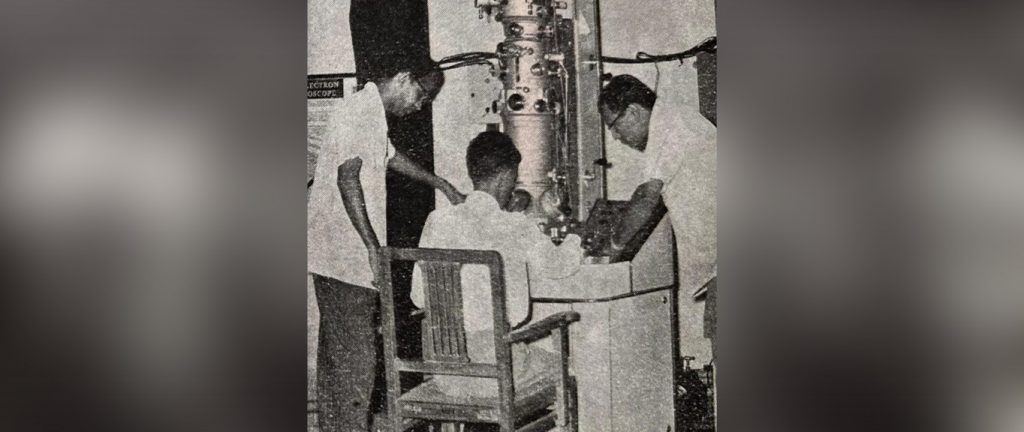
Working on the electron microscope
Thrills, spills, pranks
At first there were two identical buildings, side by side, for teaching and storage. Combined classes were held in one of these. Different teachers rotated lectures in that single classroom.
Assigned seats were numbered in white paint on the back of chairs attached to desks, indicating roll numbers. Sitting accordingly, an Agrawal, for instance, heard professors better and saw the blackboard clearer than a Vishwanath, who was practically in the last row alongside Jugal Tandon.
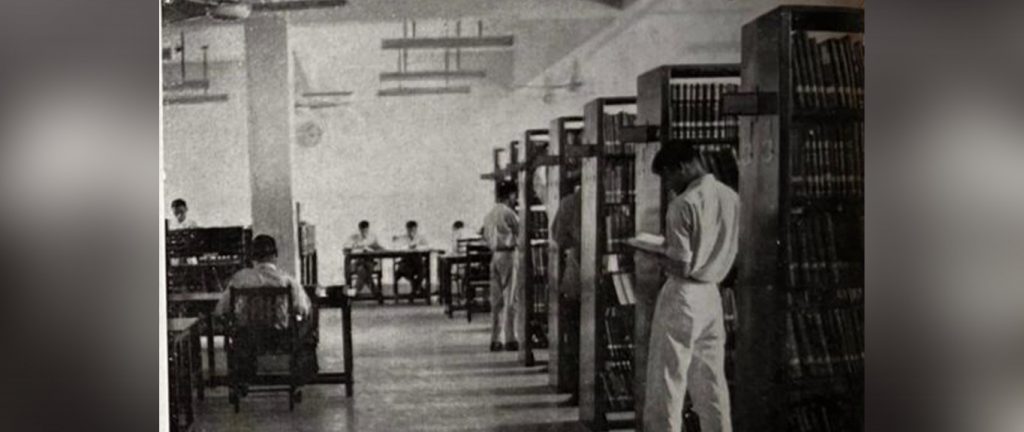
Referencing in the Central Library
On politely complaining to the institute Director, Brigadier SK Bose, Tekal Vishwanath (Civil Engineering) was told nothing could be done about the military-style system. The reasoning was, teachers should not waste 15 minutes taking attendance of 100 students. They simply looked at empty seats and noted absentees. Vishwanath struggled for a few months until the main building was ready. The staff hostel located near the shores of Powai Lake housed faculty members, including those with families.
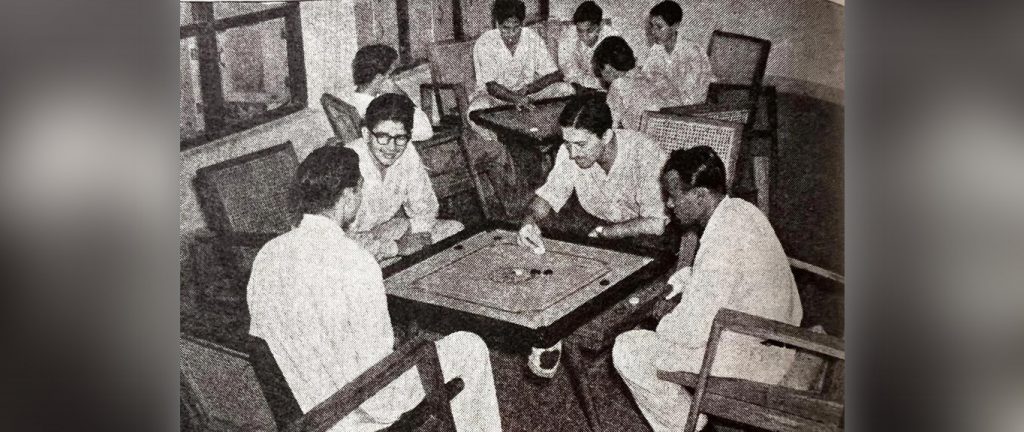
Carrom game in the hostel lounge
As a shortcut to Vihar Lake, hostelites walked on a pair of six feet-diameter pipelines carrying drinking water to the city of Bombay. Cautioned to beware of snakes, despite wearing knee-high, rubber gumboots in monsoon months, students swapped “snake stories”. A campus doctor with a reputation of being “a horse doctor”, did come through for students stung badly by scorpions.
Vishwanath says, “We paid 50 paise for movies every Friday on the roof of the main building (open air theatre) until Lecture Hall was built, where they were shown later. I went regularly because it was cheaper on campus than going to Bombay cinemas.”
The third year, 1960, saw the publication of an annual magazine called Pragati. It carried prize-winning articles on subjects like UFOs and rockets and satellites, authored by the batch. This was followed by the popular Wallpaper.
Volleyball and basketball were keenly contested sports. The first basketball match, between the IIT-B team and MES (Military Engineer Services), Kirkee, ended in defeat for IIT. Although hailing from MES, Director, Brigadier Bose quickly asked the Russian professor to coach his boys. (In recognition of IIT-B as a premier university, the first foreign aid came in Russian rubles via UNESCO. Ten UNESCO experts, eight from the Soviet Union and one each from USA and Yugoslavia, were attached to the institute at its start.)
The volleyball squad fared better. Tandon says, “There was an army camp on the grounds with wilderness around. We’d keep imagining all the rum they were having! In volleyball matches against them we won, obviously.” In an amusing aside, he adds, “No less than 10 kilos of gulal were needed for our first Holi in Powai with professors and their families.”
Sharma points out, “Classes were memorable for a variety of reasons, not necessarily academic.” Pranks were routinely attempted. Barking dogs were smuggled into class. The target of such an episode in his Strength of Material class, Professor KVA Pandalai gamely quipped, “I don’t care if you even bring your girlfriend.”
B Ramamurthy (Civil Engineering) has noted: “In the metallurgical laboratory we had to look at the polished surface of a steel piece through a microscope and sketch the crystal patterns on the record notebook inside a circle. I used to write something in Tamil and shade it at random and that was approved.”
Another Civil Engineering student, Manmohan Chitkara, once received his railway ticket from Vikhroli to VT not punched with a date. It became hot property, passed onward for quite a while.
Fun and foolery notwithstanding, learning to live together was far from easy. Sharma, who came from Agra, says, “There were several adjustments to be made, away from home in a hostel with 100 others of similar age. We had to get along, regardless of disagreements from time to time. Nothing significant.”
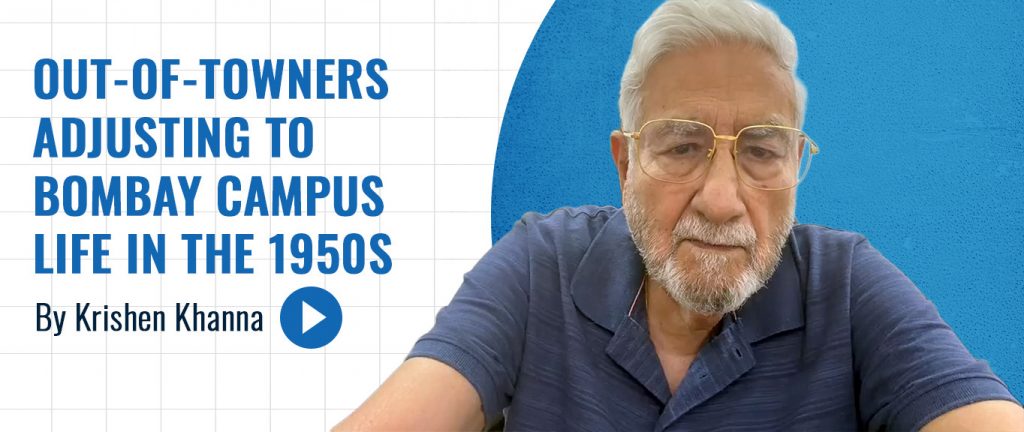
Krishen Khanna on out-of-towners adjusting to Bombay campus life in the 1950s
“The IIT years have been the most memorable, life-shaping period, to make me a confident professional,” says Krishen Khanna (Chemical Engineering) in Nashik, the man behind the craft beer brand, Independence Brewing Company. His family from West Pakistan settled in Calcutta after Partition. “I grew up in Kolkata, the leading city at that time. In comparison, Mumbai looked backward. The languages were Marathi and Gujarati. It took time getting used to how the city worked, particularly the rough bus conductors. It was tough, parked in the makeshift hostel in Worli – with up to 15 per room. Adjusting to these conditions built a very strong bond between us. The pressure on studies was immense. But more than just good teachers, our professors were great guys – mentors, guides and close friends.
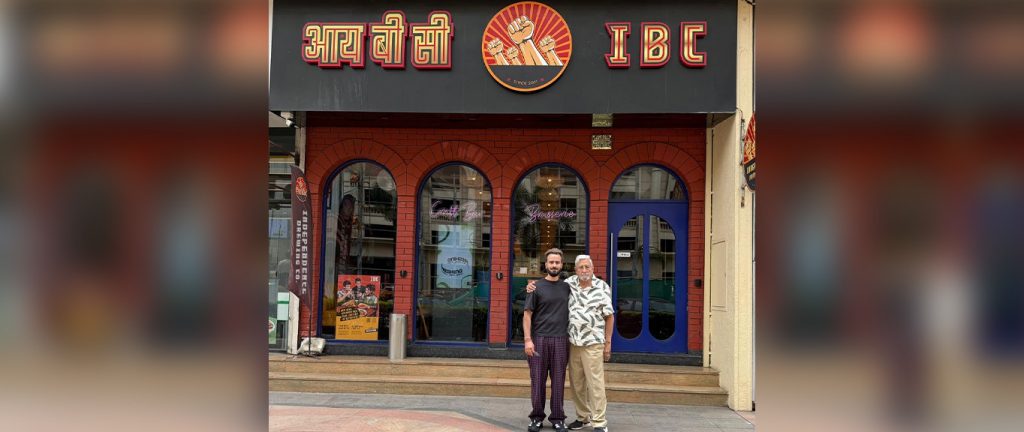
Krishen Khanna with son Anirudh outside the Powai branch of their Independence Brewing Company
Cross-country by train
“I’m forever grateful for a unique experience in the summer vacation between our third and fourth year,” says Dias. “A carriage reserved for our tour, attached to different trains at various points of the cross-country train trip. We removed planks from our hostel beds, spanning them across upper berths to accommodate one more person. There were no 2 or 3-tier sleepers then.”
The itinerary’s scheduled stops were calculated to ignite every engineer’s interest. In Bangalore they visited the Integral Coach Factory and HAL making aircraft. There was a power station in Madras, the Hindustan Shipyard in Vishakhapatnam, Howrah Bridge in Calcutta, the steel plant in Rourkela, TELCO in Jamshedpur, township cement works in Chandigarh, the Bhakra Nangal dam across Punjab and Himachal Pradesh, industrial exhibitions in New Delhi and heavy electrical plant in Bhopal.
Sharma offers flashes of incidents at some spots… On the way to Bangalore there was a change of train at Arkonam – a more than 10-hour layover in the small town. After 6-anna dosas, they bought 8-anna (50 paise) tickets for a Shivaji Ganesan film and were bitten by bugs in wooden seats of the ramshackle theatre. In Calcutta they watched Hum Dono and Jailhouse Rock. Shivering through cold showers at Chandigarh Station at 5 am en route to Bhakra, they bathed at Khurda Road under the water delivery pipe for steam locomotives by the track.
Aboard the train was time for Scrabble and whisky-drinking competitions. All of which were disrupted by an accidental blaze on the Bhopal-to-Bombay leg. Gangmen had missed connecting the vacuum hosepipe of their compartment to the rest of the train. The fault led to overheated wheels sparking the fire. Shouting, screaming, waving flags to attract attention at wayside stations, students started to chant the Hanuman Chalisa. One says, “A professor desperate to jump out had to be restrained. Finally, we all survived to build the country.”
Convocation, reunions, the Legacy Project
The faculty hosted a formal dinner on the Staff Hostel lawn near the lake front, to the outgoing batch before final exams in April 1962. The 8 pm-to-midnight white tablecloth gala buffet evening was livened with no dancing though – where were the girls at IIT-B back then.
The convocation of their graduation took place on December 22, 1962 on the grounds where the current main auditorium stands, graced by Dr Sarvepalli Radhakrishnan, the country’s distinguished second President.
The class with a conscience was particularly sensitive to the idea of giving back to their institute. “The Legacy Project importantly proved that, despite having graduated decades earlier, we were aware of how crucial the latest technology is,” says Tandon.
In December 2007, batchmates brainstormed on ways to create a lasting contribution. Director, Dr Ashok Mishra, suggested establishing a Chair that gave status and finance to attract teachers of the best calibre. It was called “1st Batch Dr PK Kelkar Chair for Excellence in Nanotechnology”, honouring the first Deputy Director, Professor PK Kelkar, a visionary educator and philosopher awarded the Padma Bhushan in 1969.
The next year, 2008 Alumni Day celebrations in December witnessed classmates from across the globe congregating at the IIT-B guesthouse. A student recalls, “Many of us met after 46 years. Recognising each other was difficult. Sometimes the voice, sometimes mannerisms, were revealing.” A few drinks simplified the process. By dinner talk turned to wives being introduced and old jokes shared. Lunch the following afternoon in Hostel No. 1 was so good that wives refused to believe the men had endured the lousy meals they claimed to have.
Reflecting on the golden jubilee in 2012, Tandon says, “Our two earlier reunions, in 1992 and 2008, were well attended but we wanted this to have the largest number assembled – a fitting tribute to mark 50 years. We’re probably the first batch to organise three IIT-B reunions. It was expected to be our last formal meet before ‘time and tide’ caught up with our travelling abilities. We were determined to make it memorable.”
Onward march…
Serendipity knocks. Barely an hours before publishing this, I am excited to hear from Subhashish Bhattacharya who leads talent acquisition at the Bangalore-based tech company Indihood. He is the son of Professor Brojo Nath Bhattacharya, who taught physics as one of IIT-B’s first 12 faculty members in 1958. “Though he was just a dad to me, who never brought work home, my father contributed in a major way to the making of IIT. He and his colleagues served with commitment, dedication and passion, in what was then a genuinely secular atmosphere. I grew up on the Powai campus for 15 years, pampered by the IIT-B family. The strength of a country is known by the institutes it has and this one certainly left its mark.”
And what do the “old boys” wish for their beloved institution? Though he would like to see IIT-B grow in emerging sciences, engineering and AI, Sharma feels the congested campus has run out of space available for buildings for newer departments. He says, “In 1991 and 1993, I spent six weeks each time in the Department of Metallurgical Engineering as a United Nations TOKTEN (Transfer Of Knowledge Through Expatriate Nationals) consultant to promote research cooperation in our fields. The campus seems more and more congested each time I see it. It has lost its old natural beauty. Thought should be given before embarking on further construction.”
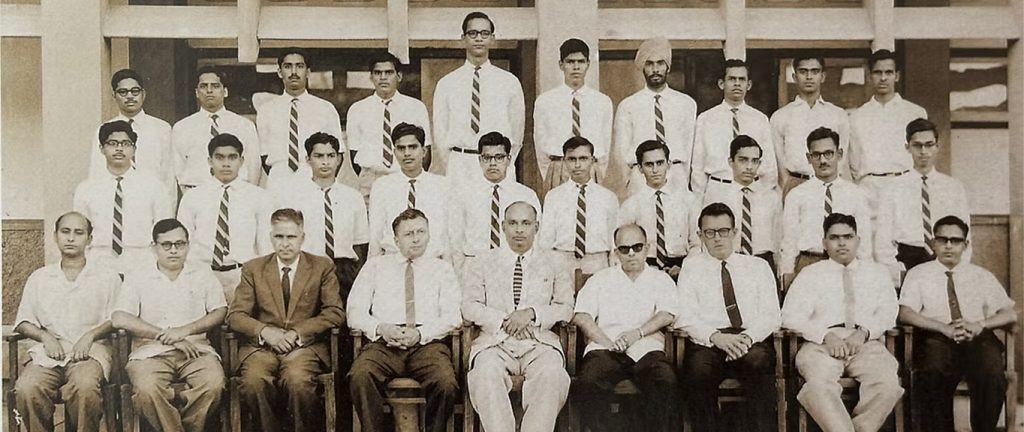
Final year Metallurgical Engineering students with faculty members
Khanna expansively declares, “I see ours as a world-renowned research and teaching institute and am pleased that alumni support it in a big way. I hope I go to IIT again in my next lifetime!”
Professor Ravi Sinha, former Dean of Alumni and Corporate Relations, remarked to ex-students, “The seeds of our present success were planted by the pioneer batch. The institute may look different now from your student days. However, the heart of an IIT-Bombay student remains rooted in the same quest for knowledge, excitement and sense of discovery.”
And Tandon concludes, “Young people from Next-Gen will come here, gain knowledge, excel in their fields and take the institute to greater glories – that is our silent prayer.”
***********
This entire article first appeared on: www.mehermarfatia.com
Copyright: Meher Marfatia / Multimedia Production & Digital Marketing: Danesh Mistry