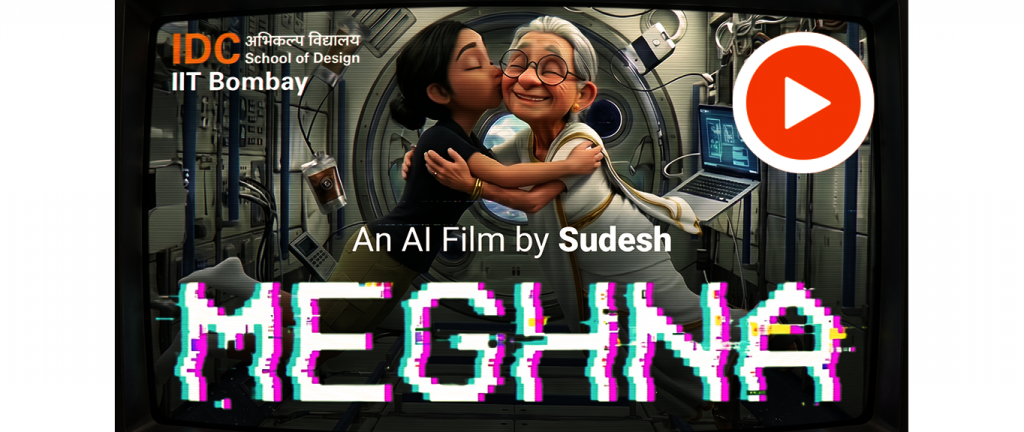
FACULTY SPOTLIGHT: Prof. Sudesh Balan
IITB’s Prof. Sudesh Balan Explores the Future of Filmmaking Through AI Short Film Meghna
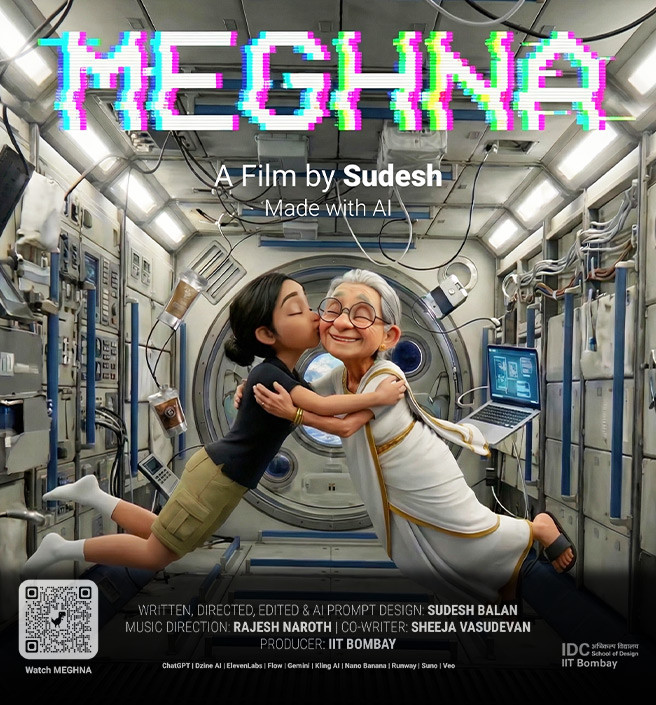
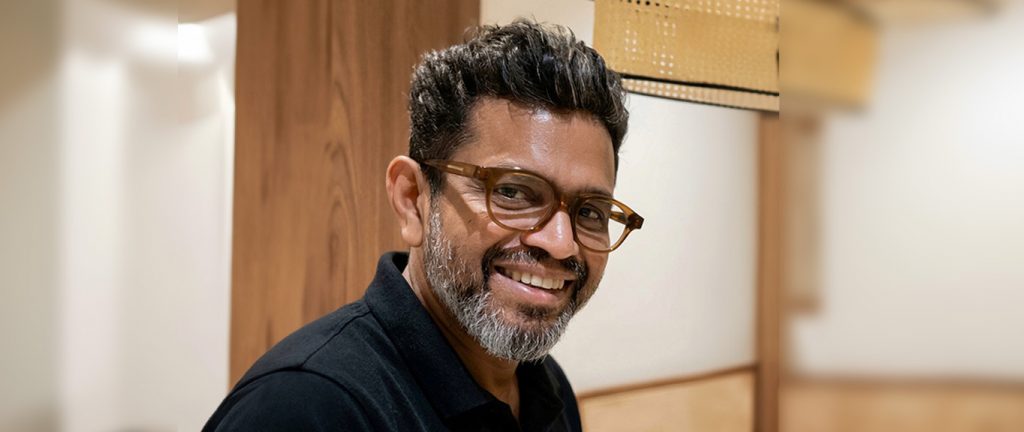
Prof. Sudesh Balan from the IDC School of Design, IIT Bombay, has created Meghna, an animated short film made using generative AI tools and workflows. Blending cutting-edge technology with emotionally resonant storytelling, the film reflects the spirit of experimentation and boundary-pushing innovation that continues to shape creative practice at IIT Bombay.
In this conversation, Prof. Balan shares insights into the making of Meghna, the possibilities of AI-assisted cinema, and the enduring role of human emotion in storytelling.
- The story of little Meghna, who was raised by her grandmother, literally shoots for the stars and becomes an astronaut. The lovely bond between the two of them, and the imagery of the two stars at the beginning that then become three — you pack a great deal of emotion and heart into a very short film. Could you take us through how and why you wanted to tell this story, and why you chose film as the medium?
The story of Meghna is inspired by many people, memories, and emotions. At the philosophical level, the film is deeply rooted in the idea of “Runanubandha” — the invisible emotional bonds that connect people. I was fascinated by how certain relationships, especially between a child and a grandparent, can become incredibly intense.
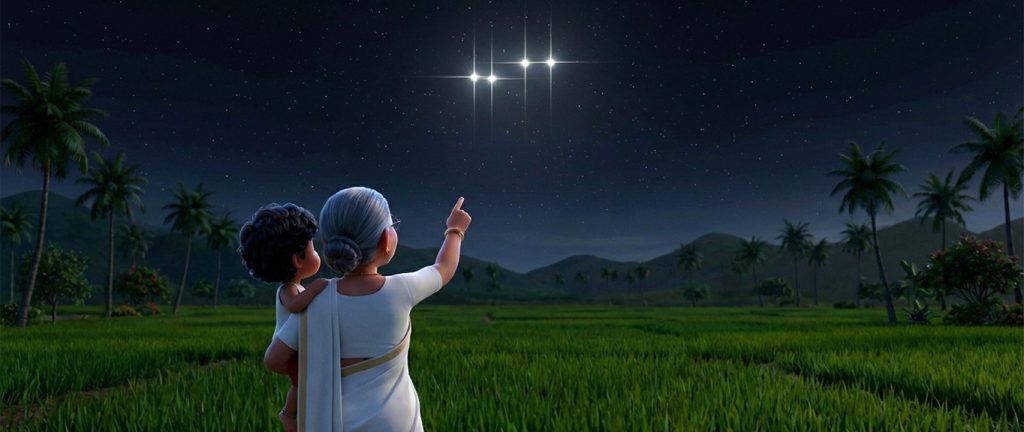
For many children, grandparents are their emotional universe. They are storytellers, protectors, and often the first people who nurture imagination. I wanted to capture that feeling through Meghna and her grandmother. The imagery of the stars also comes from something many of us grew up hearing — that our loved ones become stars watching over us from above, or that good souls go to heaven. Meghna internalises that idea as a child. Her dream of becoming an astronaut is emotionally driven: she wants to go closer to the sky, closer to the memory of her parents.
Astronauts often experience the “overview effect,” a profound shift in their perception of humanity and world when they view Earth from space. This cognitive shift is hinted at when little Meghna looks upward, flies paper planes, imagines flight, and envisions the connection with her parents.
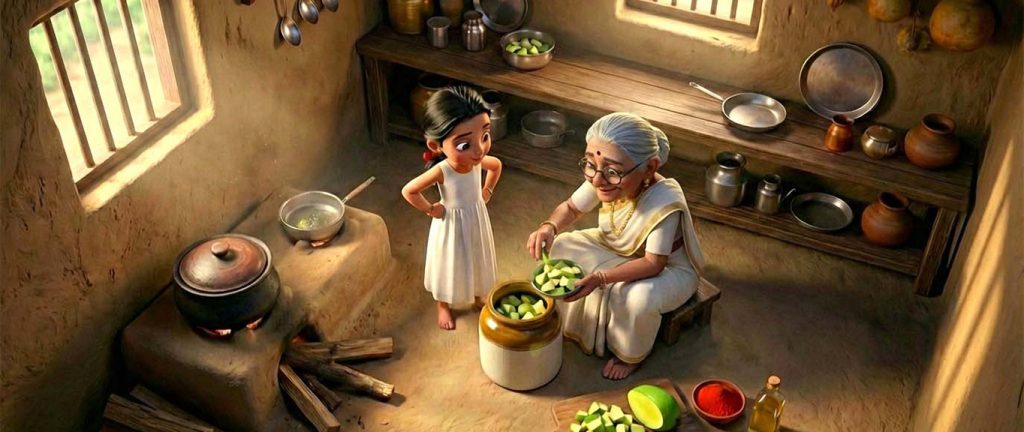
A lot of the film’s visual world comes from my own childhood memories of Kerala—the paddy fields, old homes, red oxide floors, wooden toys, Onam celebrations, watching news and live events on Doordarshan on CRT televisions, and my grandmother making pickles in the kitchen, etc. I wanted the film to feel culturally familiar, even as it moves into space and science fiction. The emotional story of Meghna was always at the center. AI simply became the medium that finally allowed me to tell it.
- What inspired you to create this film using generative AI tools?
Originally, I wanted to create this film as a live-action short. However, certain sequences — like weightlessness and the grandmother appearing inside a space station — would have required expensive set design, virtual production infrastructure, wire work, and heavy VFX. Creating certain sequences in live action — especially the space-related imagery — would have been extremely difficult and expensive. Securing the necessary budget was not feasible.
At the same time, generative AI tools were rapidly evolving, and I was very keen to explore them. I realised that an animated format would be more forgiving when it comes to the imperfections of generative AI. I waited almost a year for the technology and workflow to mature to a certain level before I could try Meghna. Earlier, the generative AI models were not able to understand many of the regional and cultural nuances I wanted to portray. These details were important to me. Things changed significantly when newer image-generation models started becoming more contextually sensitive.
Around late 2025, when models like Nano Banana began showing stronger capabilities in interpreting nuanced prompts and cinematic consistency, I suddenly felt that making Meghna is finally possible. Once I found a workflow that felt right, the production moved very quickly — around 80 hours of image/video generation in 20 days and roughly four days dedicated to editing.
What excited me most was the democratisation of filmmaking. Cinema has traditionally required enormous infrastructure, budgets, crews, and access to technology. Generative AI is beginning to lower some of these barriers. It allows independent creators to imagine visually ambitious stories that may otherwise remain unrealised. For me, that is incredibly powerful.
- The film has a very emotional and human core despite being AI-generated. How did you approach balancing technology with storytelling and emotion?
For me, the emotional core always came first. The script and storyboard were fully developed manually before starting the prompting process. So, the film was never an experiment searching for a story afterward; it was always a story searching for a way to tell it.
One thing I was very conscious of was avoiding an overly polished “AI look.” Since the film deals with memory and emotional connection, I wanted the visuals to feel more organic. I intentionally downgraded 4K output footage to full HD and added film grain to the footage so that it carried a slightly imperfect, organic quality rather than a clean digital aesthetic.
The two strongest emotional anchors for me were memory and grief. Meghna’s journey is intended to trigger the viewer’s desire to reconnect and emotionally reach someone who is no longer physically present. Even though the film ventures into science fiction and space imagery, it is still a very intimate human story.
Interestingly, even the sound and music were also generated using AI tools, but the editing itself was done manually with great care. I think editing is where emotional rhythm truly emerges. The pauses, transitions, reactions, and pacing are what create emotional connection for audiences.
There were definitely moments where the generated footage felt emotionally empty or visually disconnected. Sometimes the AI would create something completely unexpected or tonally wrong. In those situations, I would reshape the prompts or even reinterpret scenes based on what the system produced. The process became a constant exchange between intention and discovery.
What was encouraging was the audience response. Most viewers connected emotionally with the film first and were not overly concerned about how it was made. Of course, there were a few people who were uncomfortable with the use of AI, which is understandable given the larger debates happening around the technology. However, the majority of audiences reacted intensely to the emotional experience itself. Only 2% of the comments were negative about the use of AI. That, to me, was a reminder that emotional storytelling still remains central, regardless of the tools being used.
- What were some of the biggest creative or technical challenges you encountered while making the film? Also, could you tell us a little about the generative AI tools and workflows you used during the process?
One of the biggest challenges was maintaining emotional and visual consistency across shots. With Meghna and Grandma aging, this became increasingly difficult. Generative AI can drastically alter facial features, expressions, textures, or the emotional tone of a scene with even small changes in prompts.
The workflow itself combined both traditional filmmaking methods and AI-based generation. The process began conventionally — with scriptwriting and storyboarding. Before deciding on the AI approach, I had also discussed and visualised parts of the film with two interns. Once the workflow became clearer, the actual generation process became mostly an individual effort, along with the music director Rajesh Naroth, who worked on the music using AI-assisted tools.
For image generation, I primarily used Nano Banana, which handled regional and cultural nuances more effectively than the earlier models I had experimented with. For video generation and animation, I utilised tools like Flow, Runway, and Kling. Audio and voice-related workflows involved using ElevenLabs and Suno, while the final editing was done manually in DaVinci Resolve. I intentionally avoided upscaling visuals to retain a textured, organic quality.
For many shots, I would generate six or seven versions before arriving at the final one. Interestingly, it was not always about generating from hundreds of prompts. Often, fewer than ten carefully thought-out prompts per shot were enough, because the real challenge was understanding how to guide the system rather than endlessly forcing it.
- There has been considerable pushback from sections of the creative community over the use of AI in filmmaking, especially from actors and technicians concerned about the impact of AI-generated cinema on creative jobs. How do you view this conversation?
I think the concerns coming from the creative community are valid and important. In the past, every major technological shift in media has created both excitement and anxiety, and AI is no exception. It is definitely going to transform workflows across filmmaking and creative industries. Certain repetitive or highly labour-intensive processes may change significantly.
I see that AI is leading to both democratisation and disruption in filmmaking. It reduces the barriers for independent creators who often lack access to huge budgets, large studios, or production facilities. In this way, it can be quite empowering. However, it will also disrupt the existing production ecosystems. So like any transformative technology, it must be approached with responsibility.
I believe that independent creators and smaller teams will benefit significantly from these tools. Ambitious visual storytelling often requires massive resources. AI gives people a chance to try new cinematic ideas. Many of these ideas were hard to execute before. It can bring new voices to the forefront. Local storytelling cultures can expand globally. Everyone can share their unique stories.
At the same time, ethical concerns are absolutely real. Questions around consent, copyright, deepfakes, training data, and ownership need serious discussion and strong regulations. Transparency about the use of AI is also important.
One thing people often misunderstand about AI filmmaking is that they assume the technology itself can automatically create meaningful cinema. However, to me, AI is still just another medium or method of expression; the emotional intent behind the work still matters the most.
- Are there any future projects or explorations in this space that you are currently working on?
At the moment, my focus is primarily on creating films rather than developing software tools. But naturally, while working repeatedly with these systems, one begins evolving personal workflows and methodologies that suit one’s own creative thinking and filmmaking process.
I am also increasingly curious about combining AI and immersive storytelling formats. One area I am actively exploring is how these kinds of cinematic experiences could evolve beyond traditional theatrical projection into VR environments and stereoscopic 3D experiences.
Through our start-up, KAMERAKAREN Studios Pvt. Ltd., founded by Dr. Sheeja Vasudevan and me, and incubated at SINE, IIT Bombay, we are exploring new ways of cinematic storytelling using emerging technologies like generative AI. Our aim is not to use technology just for novelty, but to find simpler, more flexible, and more accessible ways to create powerful stories while staying rooted in filmmaking craft. We are especially interested in how Indian stories can be made to reach mass audiences in meaningful ways.
What excites me the most is the creative freedom these tools provide. In the past, many film ideas stayed just in our imagination because of practical challenges or lack of financial resources. Now, with just a computer and good ideas, one filmmaker can try out concepts that would otherwise need a whole studio team. This change is very exciting because it allows for more personal, intimate, and experimental types of films to be made.
******************
Curious to see how these ideas come alive on screen?
Experience Meghna, the fully AI-generated animated short film by Prof. Sudesh Balan, and see firsthand how technology, emotion, memory, and storytelling come together in this deeply moving cinematic journey.